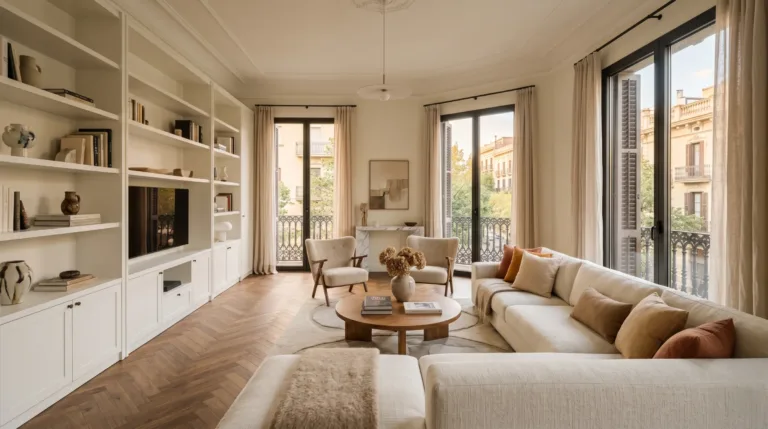
The Gothic Quarter is the oldest continuously inhabited urban core in Barcelona. Its residential buildings range from medieval structures with Roman foundations to nineteenth century infill. The street pattern has changed remarkably little over five centuries. Renovating here offers the opportunity to work with architecture that has no equivalent elsewhere in the city. But it also demands regulatory knowledge, structural caution, and logistical preparation that exceed any other Barcelona district.
Owners who bring the same assumptions they would apply to an Eixample project will encounter serious difficulties. Those who understand what the district requires from the outset consistently achieve results — and returns — that justify the additional complexity.
What makes the Gothic Quarter different
The residential building stock in the Gothic Quarter is uniquely layered. Many buildings incorporate structural elements from multiple historical periods. Roman or medieval masonry sits at lower levels. Gothic-period vaulting and stonework appear above. Renaissance or Baroque modifications altered façades and interior configurations. Nineteenth and early twentieth century upgrades then added modern service infrastructure. In some buildings, all of these periods coexist within a single structure.
This layering has significant implications for renovation planning. Layout changes that appear straightforward on a floor plan can reveal load-bearing arches, buried medieval walls, or original stone paving at unexpected locations. When workers discover archaeologically significant material, Catalan cultural heritage law requires immediate notification to the authorities. Works must suspend pending review. The street pattern of the Gothic Quarter — narrow lanes, irregular block shapes, limited vehicular access — adds further logistics constraints that are among the most demanding in Barcelona.
Heritage protection: what applies to your building
The Gothic Quarter operates under the most intensive heritage protection framework in Barcelona. The district sits within a Special Protection Plan that applies area-level restrictions across the entire neighbourhood. Individual building cataloguing covers a high proportion of residential structures on top of this.
Level A and Level B protected buildings concentrate in the historic core around the Cathedral, Plaça de Sant Jaume, and the original Roman settlement streets. In these buildings, any works affecting original fabric — stone walls, vaulted ceilings, original floor levels, historic paving, façades, internal courtyards, and staircases — require prior Heritage Department approval. This runs in parallel with, and in addition to, the standard Ajuntament permit process.
Even Level C and D buildings in the Gothic Quarter carry restrictions that would not apply to equivalent buildings in other districts. The working assumption for any renovation here: Heritage Department involvement will be required. That adds both time and documentation requirements to the project.
Why structural assessment comes first
In no other Barcelona district does the pre-design structural assessment matter more. Workers cannot infer structural behaviour from visual inspection alone. Walls that appear to be simple partitions may be load-bearing medieval masonry. What looks like a solid floor may conceal a historic vault. Foundations may extend to Roman-period levels below the current floor surface.
Every layout change, every wall removal, and every intervention involving the building envelope must follow a structural assessment by a licensed structural engineer with experience in historic masonry construction. This is not a precaution — it determines whether the intended design is achievable at all.
Archaeological risk
The Gothic Quarter is an active archaeological zone. Any excavation works — drainage upgrades, underfloor heating installation, or structural reinforcement at foundation level — carry a real risk of encountering archaeologically significant material. Catalan law requires workers to report such discoveries and suspend works pending assessment by the cultural heritage authorities. Project teams cannot predict this timeline in advance. Any excavation programme must treat archaeological suspension as a genuine and budgeted risk.
Access and logistics
The Gothic Quarter has some of the most constrained construction access in Barcelona. Many streets are pedestrian-only or carry vehicle access restrictions. Standard construction vehicles cannot reach much of the district. Material delivery and demolition waste removal require coordinated manual handling operations, often over lengthy carry distances.
Scaffold installation on Gothic Quarter buildings frequently requires partial occupation of public space. Teams must coordinate this with the Districte de Ciutat Vella, and it typically requires specific municipal permits beyond the standard construction licence. Managing community relations with neighbours is equally important. Construction noise and disruption are acutely felt in a dense historic neighbourhood.
Hidden conditions and contingency planning
Gothic Quarter apartments produce the highest rate of unexpected structural, waterproofing, and infrastructure discoveries of any property type in Barcelona. Damp penetration through ancient masonry, buried service infrastructure from previous building configurations, partially collapsed internal structures, and original materials that workers cannot legally remove are all regularly encountered once demolition begins. Treat a 20% contingency as the minimum in this district — not a conservative estimate.
What renovation adds value
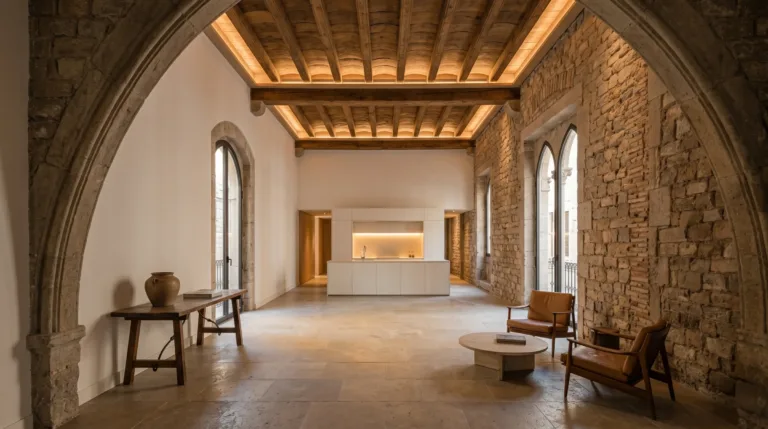
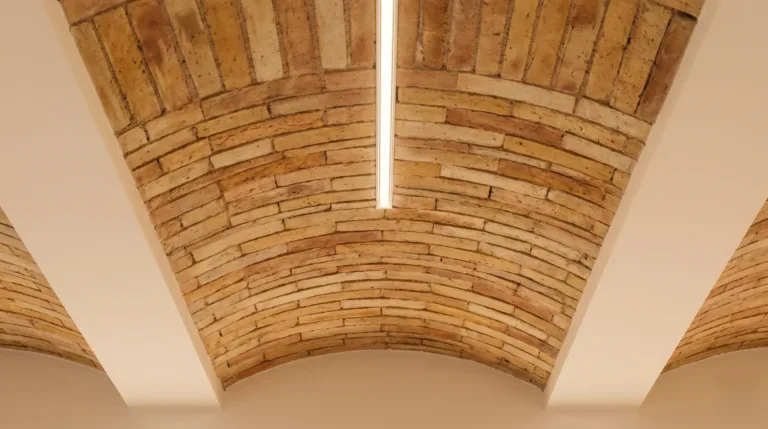
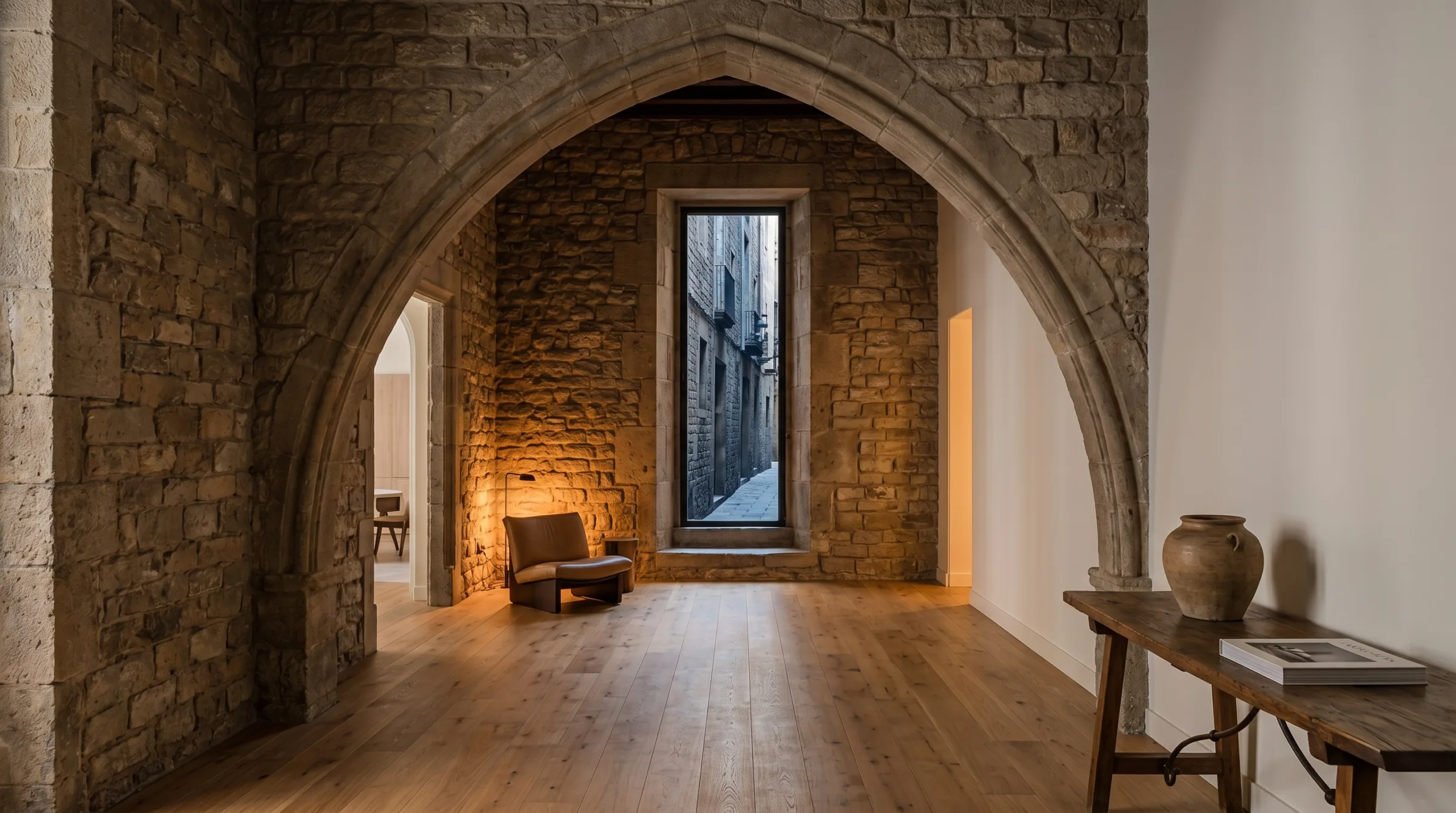
Authentic character, thoughtfully integrated. Buyers who choose the Gothic Quarter over more accessible Barcelona districts specifically seek the quality of the architectural fabric. A renovation that exposes and celebrates original stone walls, vaulted ceilings, historic tile floors, and timber beams — integrating them with contemporary lighting, bespoke joinery, and high-quality finishes — produces properties that are genuinely irreplaceable in the market. Renovations that neutralise this character in favour of a generic contemporary finish consistently underperform.
Light. Gothic Quarter apartments, particularly on lower floors and interior-facing sides, can be very dark. Any design intervention that improves natural light distribution adds disproportionate value. Enlarged internal openings, light-reflective finishes, and considered artificial lighting design that compensates for limited daylight all perform well. This is often the highest-ROI design decision available within heritage constraints.
Technical renewal done properly. Buyers at the premium end of this market conduct thorough technical due diligence before purchase. Full electrical replacement to current standards, new water supply and drainage, and properly installed climate control are baseline expectations. Gothic Quarter buildings often lack sufficient ceiling voids for ducted systems, so split-system or fan coil solutions are the practical standard. The expectation of modern, functional infrastructure remains non-negotiable.
Storage solutions. Gothic Quarter apartments are rarely generous with storage. Bespoke joinery solutions — built into thick masonry walls, integrated into staircase configurations, designed into bedroom layouts — add practical and commercial value in a segment where buyers already know scarcity is structural.
What rarely pays off
Over-specification relative to the specific building and location within the Gothic Quarter erodes margins. A mid-tier building on a secondary lane will not return the same value from ultra-premium finishes as a first-floor apartment in a prime heritage building on a principal street. Calibrate specification to the specific property, not to an abstract luxury standard.
Renovations that erase the building’s original character entirely also underperform. The Gothic Quarter’s premium is inseparable from its architectural authenticity. A renovation that could be in any European city loses the location premium.
Permit requirements
Standard Barcelona permit tiers apply in classification. In practice, most projects of any meaningful scope will require Heritage Department involvement:
- Cosmetic works in non-protected buildings: Assabentat d’Obres — no architectural project required. Rare in practice given the district’s protection coverage.
- Layout modifications without structural works: Comunicat d’Obres in principle, but Heritage review is triggered in most catalogued buildings. This extends timelines significantly.
- Structural works, façade modifications, works in any protected building, or any excavation: Llicència d’Obres Majors — full architectural project required. Heritage Department review is mandatory. Approval timelines run 6 to 12+ months.
Work with an architect who has an established relationship with Barcelona’s Heritage Department and direct experience of Gothic Quarter permit submissions. Knowledge of the specific review criteria and documentation standards materially affects both approval probability and timeline.
Typical renovation costs
The Gothic Quarter sits at the highest end of Barcelona renovation costs. Structural complexity, heritage constraints, logistics costs, archaeological risk, and specialist skills for historic fabric restoration all drive costs upward:
- Standard renovation in a non-protected or lower-tier protected building: €1,500 – €2,000 per m²
- Full renovation with heritage fabric restoration in a Level B or higher building: €2,200 – €4,000+ per m²
Set a 20% contingency from the outset. Do not treat it as a reserve for scope additions — it exists for structural and heritage discoveries that emerge during the works.
Timeline expectations
Gothic Quarter renovation projects carry the longest typical elapsed timelines in Barcelona:
- 3 to 6 weeks: initial assessment including structural inspection, heritage review, and archaeological risk evaluation
- 4 to 8 weeks: design and technical documentation
- 6 to 12+ months: permit and Heritage Department approval in protected buildings
- 5 to 9 months: construction
Total elapsed time from initial consultation to handover commonly runs 14 to 22 months for projects in Level A or Level B protected buildings. Communicate this reality clearly to all parties from the first conversation.
Practical advice for property owners
- Commission a heritage and archaeological risk assessment before producing any design brief
- Budget 20% contingency from day one — treat it as a structural project cost, not a reserve
- Work with an architect with direct Gothic Quarter permit experience, not just general Barcelona experience
- Plan material delivery and waste removal logistics as a dedicated workstream — access constraints here carry significant budget implications
- Do not set fixed completion dates until the Ajuntament confirms the permit in writing
- Prepare for the possibility that excavation works will suspend pending archaeological review
Conclusion
The Gothic Quarter is the most demanding renovation environment in Barcelona. It also rewards owners who approach it with the right preparation. The architectural quality available here — medieval stone, historic vaulting, original floors, streets unchanged for centuries — exists nowhere else in the city. A renovation executed with the right expertise, the right patience, and the right contingency planning produces a property with a permanence and character that justifies every hour of the process.